Posted on Leave a comment

Charlotte Mint

The Charlotte Mint was the first United States branch mint. It was located in Charlotte, North Carolina and specialized in gold coinage. Following the primary documented discovery of gold withinside the United States, the country’s first gold mine became installed in North Carolina on the Reed Gold Mine. As no mints existed withinside the Charlotte area, miners needed to ship their gold dirt to Philadelphia to be melted and coined. The transportation procedure became difficult, slow, expensive, and dangerous; frustration with this device brought about the advent of personal gold coining operations withinside the Charlotte area. However, making gold into nearby cash had its personal inherent problems, along with correct weighing and figuring out fineness. In the spring of 1831, North Carolina traders and miners petitioned Congress for a department mint withinside the Charlotte location to lessen the chance of transporting gold. They acquired no reaction till 3 years later while the US Treasury commenced to analyze non-public coining operations and diagnosed North Carolina’s want for greater federal coinage.In November, 1835, Levi Woodbury, Secretary of the Treasury, became notified by Samuel MeComb that he had bought from William Carson and F. L. Smith a complete rectangular containing four acres of land for $1,500.00, that’s now the four hundred block of West Trade Street. Proposals for erection of the constructing had been marketed and the settlement became presented to Perry & Ligon, of Raleigh, NC on October 15, 1835 at a fee of $29,800.00. In 1836, production at the Charlotte Mint began. It opened for commercial enterprise on July 27, 1837. Only uncooked gold became processed and subtle till March 28, 1838, whilst the first $5 gold 1/2 of eagle became struck in Charlotte.

Posted on Leave a comment

Dahlonega Mint

When the Georgia Gold Rush began in the Mid- 1800’s, a branch of the United States Mint was built in Dahlonega, Lumpkin County, to enable Miners to Assay and Mint their Gold without having to travel to Philadelphia. The mint produced coins every year from 1838 through 1861. The commissioner, Ignatius Alphonso Few, purchased ten acres south of Dahlonega for $1,050 (equivalent to $27,581 today) in August 1835. He then hired architect Benjamin Towns, who was the lowest bidder, for $33,450 (equivalent to $878,656 today), to build the mint in under eighteen months. A flywheel, a drawing frame, a crankshaft, a coining press, and eighteen annealing pans were among the pieces of mint equipment that were erected in 1837. “Fifty to sixty gold coins could be produced by the coining press every minute.” Even though this mint is not currently in operation its legacy lives on.

Posted on Leave a comment

The History of the Roosevelt Dime

1950 Proof Roosevelt Dime Obverse and Reverse

The Roosevelt dime was minted in 1946 and replaced the Mercury dime. It weighs about 2.268 Grams and the diameter is 17.91 Millimeters or 0.705 of an inch and the edges are reeded. The designer, John R. Sinnock was also the designer of the Franklin half dollar. His initials can be found at the bottom of the dime below Franklin D. Roosevelt’s Neck. John R. Sinnock is also the designer of the Purple Heart Medal. After the initial minting of the Roosevelt dime in 1946, a false narrative  in the United States broke out stating that the letters “JS” actually stood not for John Sinnock, but for Joseph Stalin. The rumor broke out again when the Franklin half dollar was minted in 1948. John Sinnock was born July 8, 1888, in Raton, New Mexico, and found himself getting educated at the Philadelphia Museum School of Industrial Art. The Roosevelt dime is still in use today and the value is 10 cents.

Written by Nevan Sawchenko – 12 Year Old Numismatist

Posted on Leave a comment

What is the Trade Dollar?

The trade dollar was minted between the years 1873-1885. The trade dollar is 90% silver and 10% copper. The designer of the trade dollar is William Barber.

What are some other coins William Barber has printed?

He has also designed the twenty-cent piece, commercial dollars, high quality medals and tokens, private coins, and a very inspiring Amazonian silver coin set in 1872.

1873 Silver Trade Dollar Obverse and Reverse. The obverse features a seated lady liberty with an olive branch. The reverse features an eagle with an olive branch.

Some other facts about the Trade Dollar

The trade dollar weighs about 27.216 grams and is about 1.5 inches in diameter. It has a reeded edge like on most coins such as the quarter and dime. The trade dollar was used for international trade amongst various different countries hence the name “trade dollar”. The trade dollar is a silver coin, so if you are trying to tell if your trade dollar is real, try to pick it up with a magnet. If you are able to pick it up that’s how you would know it is fake. The 1884 and 1885 trade dollars are the rarest and most valuable trade dollars there is.

Written by Nevan Sawchenko – 12 Year Old Numismatist

Posted on Leave a comment

Who Was Titus? | Ancient Roman Coins

Titus Flavius Vespasianus was the hero of the Judean rebellion (from the Roman perspective) and a very popular emperor.

He was emperor during some very trying times including the cataclysmic eruption of Vesuvius, which buried half the towns of the Bay of Naples, including Pompeii in 79 AD and a fire in Rome in 80 AD. He was described as handsome, charming and generous. Titus once complained that he had lost a day because twenty-four hours passed without his bestowing a gift. He was, however, generous to a fault, which depleted the treasury. If he had ruled longer, he might have brought the empire to bankruptcy and lost his popularity. He died of illness in 81 A.D., succeeded by his brother Domitian.

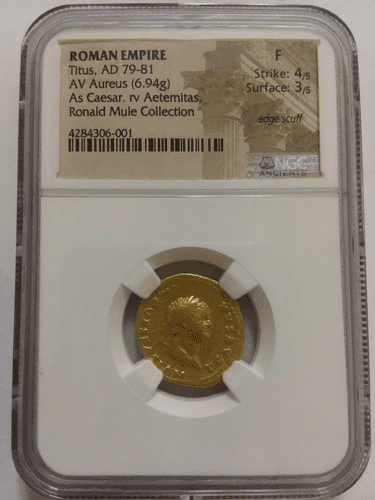
Up for sale is an Ancient Roman Gold Coin Titus, graded by NGC as an F with strike: 4 of 5 and surface: 3 of 5. There is also an edge scuff. Otherwise, the coin is in excellent condition. Own a piece of ancient history today!

Posted on Leave a comment

181 Year Old Shipwreck Yields Some of the Rarest US coins Ever Found

4 Shipwreck Gold Coins recovered from the 1838 Pulaski Steamship. 3 Coins are rusted brown and blue, while 1 gold coin is in great condition.

4 Shipwreck Gold Coins recovered from the 1838 Pulaski Steamship. 3 Coins are rusted brown and blue, while 1 gold coin is in great condition.

On June 14th, 1838, a boiler explosion caused the Pulaski Steamship to sink approximately 30 miles off the coast of North Carolina. Two-thirds of the passengers and crew on-board were lost as a result of this disaster.  

A majority of the individuals who traveled on ships like this were wealthy and were known to take their fortunes on trips like this. Because this ship went down so quickly, it was very difficult to save any of it while simultaneously trying to make it off the ship safely.

Recently, the ship was discovered along with 502 Gold & Silver Coins, some of which date back to the 1750s.

All 502 gold and silver coins were already sold to a global coin dealer at an undisclosed price. However, the recovery project stated that the price “wildly exceeded” the recovery project’s expectations. It is speculated that there are still hundreds of coins to be discovered. 

Posted on Leave a comment

The Gold Bullion Act of 1985 & the Birth of the American Gold Eagle

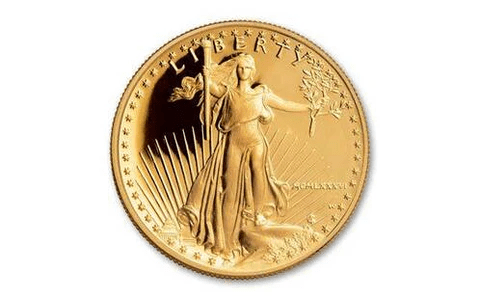
American Proof Gold Eagle

American Proof Gold Eagle

During the 1980s, the South African Gold Krugerrand and the Canadian Gold Maple Leaf were extremely popular coins in the United States. In 1984, over $600 million worth of Krugerrands were marketed in the United States. However, people began to react to the racial tensions in South Africa and sales plummeted. Eventually, President Reagan banned the Krugerrands as a way of taking an economic stand against the South African government. This crippled the South African mint as half of their sales were derived from the United States.

Although there were still Canadian Maple Leafs available, the US Government decided to help fill the void by making their own coins. This void was especially large during the 1980s due to various factors such as US-Russia relations, unemployment, and problems with Social Security.

As a result, the US created The Gold Bullion Coin Act. This act required that the U.S. Mint start producing 22-karat gold bullion coins in different sizes and denominations ($50, $25, $10, $5). The Act specified the exact dimensions and designs of the coins. The Act mandated that enough coins be produced to meet the public’s demand assuming that the resources were available to meet said productions numbers. For example, the 2009 Gold Coins were canceled as the mint could not keep up with the demand caused by the Great Recession of 2008.

Other rules set by the Act include using only natural deposits from U.S. territories within 1 year of being mined, not paying more than the average world price for gold, and using profit obtained from the sale of coins solely for reducing the national debt.

This legislation was a groundbreaking achievement. It got the U.S. a piece of the national and global coin market and established one of the most popular gold bullion coins ever: the American Gold Eagle.

Posted on Leave a comment

History of the U.S. Penny

2013 S Lincoln Penny Obverse
The U.S. penny is a coin worth one-hundredth of a U.S. dollar. The obverse side has depicted Abraham Lincoln since 1909, the centennial of his birth. The reverse side depicted the Lincoln Memorial from 1959 to 2008. Four different reverse designs in 2009 honored Lincoln’s 200th birthday, and in 2010, a new “permanent” reverse — the Union Shield — was released.  The term “penny” derives from the British coin of the same name.

The penny has gone through many different variations over its two-hundred-year existence. Until about 1857, it was about the size of the current US dollar coin. Here are a few notable examples of the US penny:

1859 Indian Head Penny Obverse & ReverseIndian Head cent (1859-1909) – ​Also known as the Indian Head penny, the Indian Head cent was designed by James Barton Longacre, then Chief Engraver at the Philadelphia Mint. The obverse side features Lady Liberty with head dress. The reverse side features laurel wreath surrounding the denomination “ONE CENT.”
1909 S Lincoln Wheat Penny Obverse & ReverseWheat cent (1909-1958) – In 1909, the U.S. Mint began producing a new penny featuring Abraham Lincoln, 1909 being the centennial year of his birth. A reverse design was produced bearing two wheatheads in memorial style. Between the two wheatheads, in the center of the coin, is the denomination “UNITED STATES OF AMERICA.” Curving around the upper border is the national motto, E Pluribus Unum, Latin for “From Many, One.”
2005 D Lincoln Memorial Penny Obverse & ReverseLincoln Memorial cent (1959-2008) – On February 2nd, 1959, a revised reverse design was introduced, commemorating the 150th anniversary of Abraham Lincoln’s birth. The design features the Lincoln memorial beneath the inscription “E PLURIBUS UNUM.”
2013 S Lincoln Penny Shield Obverse & ReverseUnion shield​ cent– (2010-present) – In 2010, a new reverse design was released featuring a Union shield with “ONE CENT” superimposed on a scroll. The design once again features the motto “E PLURIBUS UNUM,” depicted on the upper portion of the shield.
Posted on Leave a comment

History of the U.S. Nickel

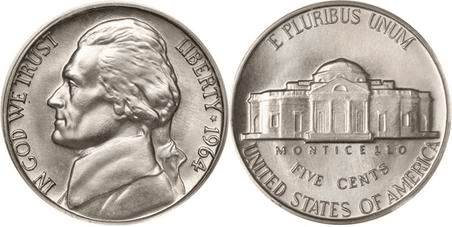
1964 Jefferson Nickel Obverse & Reverse

1964 Jefferson Nickel Obverse & Reverse

The U.S. nickel is a five-cent coin struck by the U.S. Mint. First issued in 1866, the coin is composed of 75% copper and 25% nickel.

The silver half dime, worth five cents, had been issued since the 1790s. The American Civil War created economic difficulty and led to gold and silver going out of circulation. Initially, the government issued paper currency in place of low-value coins.  However, after the successful introduction of two-cent and three-cent pieces without precious metal, Congress authorized the five-cent piece composed of base metal.

There have been several versions of the nickel released over the years. Here are a few notable examples:

Shield Nickel Coin Obverse & Reverse. Obverse features "In God We Trust" A union shield, and 1883. The Reverse features a 5 surrounded by stars and United States of America.Shield nickel (1866-1883) – The shield nickel was the first version of the nickel released in 1866. It was designed by the U.S. Mint’s Chief Engraver, James B. Longacre. The obverse side features a shield surmounted by a cross, while the reverse side features a numeral 5 surrounded by stars. The design was widely criticized, and the American Journal of Numismatics even described it as “the ugliest of all known coins.”

1883 Liberty V Nickel Obverse & Reverse. Obverse features Lady Liberty Bust Profile surrounded by stars. Reverse features Roman Numeral V surrounded by wreath, United States of America, and E Pluribus UnumLiberty Head or “V” nickel (1883-1913) – In 1881, Philadelphia Mint Superintendent Archibald Loudon Sowden ordered Mint Engraver Charles Barber to produce new designs for a cent, three-cent, and five-cent pieces. Snowden required that the new coins’ obverse side feature the head of Liberty with the inscription “LIBERTY,” with the nickel’s reverse to feature a wreath of wheat, cotton, and corn around a Roman numeral “V” or 5. The Liberty Head was heavily struck during the thirty years of its circulation.

1918 Buffalo Nickel Obverse & Reverse.

Buffalo or Indian Head nickel (1913-1938) – On May 4, 1911, Eames MacVeigh, son of Treasury Secretary Franklin MacVeigh, wrote a letter to his father recommending that he take the opportunity to beautify the design of the nickel. Soon after the MacVeigh’s letter, it was announced that the Mint would solicit new designs for the nickel.  Sculptor James Earle Fraser approached the mint with a design that featured a Native American on the obverse side and a bison on the reverse side. The Buffalo nickel was released into circulation on March 4, 1913, and quickly gained acclaim for depicting strong American themes.

1964 Jefferson Nickel Obverse & Reverse

Jefferson nickel (1938-present) – In January 1938, the U.S. Mint announced an open competition to design the new nickel, with a $1,000 prize for the winner. On April 24, Felix Schlag was announced as the winner. His design featured the portrait of Thomas Jefferson on the obverse side, with his house Monticello on the reverse side.


Posted on Leave a comment

How to Invest in Numismatic Coins

Gold Indian Coin Obverse and a 10 oz silver bar

Are you new to investing in silver and gold? Do you know the difference between numismatic and bullion? The difference between rounds and bars? The difference between spot and premium prices? If you don’t know where to start, you’ll need to understand the basics and the differences of the terms mentioned above.

Numismatic coins are collectible and rare. Bullion coins are valued for their melt value in silver and gold. Which should one invest in? Numismatic coins are valuable because their historical background, mint marks, design, year of mintage, and coin population. Bullion coins are only valuable for their precious metal content.

Bullion Coin Value

When investing in bullion, you’ll be looking at coins, bars, and rounds. As mentioned previously, bullion coin value comes from precious metal content. This means that the price is constantly changing based on what the market dictates. Bullion coins are struck by the mint; most can be used for legal tender. Bars are rectangular bars made entirely of precious metal such as silver or gold. Rounds are flat rounds that are also made of precious metal. Both bars and rounds are struck at private mints.

Spot Price vs. Premium Price

When purchasing precious metal, you’ll encounter spot price and premium price. Spot price is the price of the precious metal in that immediate time. Premium price refers to the price that includes production costs, such as fabrication and distribution, and potentially any numismatic value the item may have.

Finding a Reputable Coin Dealer

The most overlooked and most important aspect of investing in coins is finding a trustworthy, reputable dealer. While it is vital to become knowledgeable of the various aspects of the industry, it is also essential to find a dealer that can help guide you and get you coins at a reasonable price. A dealer that is looking out for your best interest and only calls every few months with legitimate coin investments is not an easy thing to come by. Unfortunately, there are various coin companies out there who are just looking to maximize their profit margins, seeing their customers as a number instead of as a person.

Contact Us Today!

If you have any questions about coins and investing, Certified Coin Consultants is here for you. Call (516) 218 – 2094 or visit our store at 8 S. Village Ave., Rockville Centre, NY.